SHAPING POLICY IN THE
UNITED STATES SENATE
SHAPING POLICY IN THE UNITED STATES SENATE
My path into federal policy didn’t start in Washington, D.C. It started at home.
Growing up Coeur d’Alene, federal policy wasn’t abstract — it was part of daily life. I saw how decisions made far away could shape real outcomes for Native people. I watched how a statute written the wrong way could create harm, and how fixing it could change everything. That awareness took shape long before I ever walked into a Senate office.
LEARNING HOW THE SYSTEM REALLY WORKS
My first real exposure to Congress came through the Udall Foundation’s Native American Congressional Internship. I worked in a Senate office and got a front-row seat to how things actually move. A few years later, I was selected as a 2015 Hatfield Fellow and served in the Senate again.
What surprised me most was how much could get done in a single day — and how human the process really is. You can spend your morning deep in research and your afternoon in meetings, hearings, and conversations. It’s fast, it’s varied, and it forces you to figure things out quickly.
But the biggest lesson was this: policy is not driven by data alone. In fact, data often comes later — after something passes, and when people measure its impact. What actually moves policy is story, relationships, and timing.
If someone can connect to an issue as a human being, that’s what turns a “maybe” into a “yes.”
FROM CONCERN TO LEGISLATION
Inside the Senate, a concern on its own doesn’t go very far. It’s just a complaint without a solution.
The real work is taking a community need and shaping it into something actionable — figuring out whether it requires new funding, a policy adjustment, or an entirely new program. From there, it’s about building relationships, finding a champion, and making it easy for decision-makers to say yes.
As a staffer, I often thought of my role as a translator. People would come in with big, important ideas, and my job was to distill them into something a senator — who is making hundreds of decisions a day — could understand quickly. What’s the core issue? What’s the solution? What’s the risk of doing nothing?
Clarity isn’t optional in those rooms. It’s everything.
WHEN STORY CHANGES THE OUTCOME
One of the most meaningful projects I worked on was tied to housing for Columbia River tribes.
For decades, Native communities displaced by dam construction were still waiting for the housing they had been promised — while non-Native communities had received support years earlier. On paper, the numbers were daunting. Early estimates came in around $140 million, which is the kind of figure that can shut a conversation down immediately.
What changed everything wasn’t a new report. It was getting decision-makers out of D.C. and into the community.
When Senator Jeff Merkley visited the fishing sites and saw firsthand how people were living — year-round in spaces never meant for long-term housing — it shifted the conversation. It wasn’t abstract anymore. It was real.
That experience turned him into a champion for the issue. And ultimately, the language we collaborated on was included in the Water Infrastructure Improvements for the Nation Act.
That’s when it clicked for me: story is what moves policy forward.


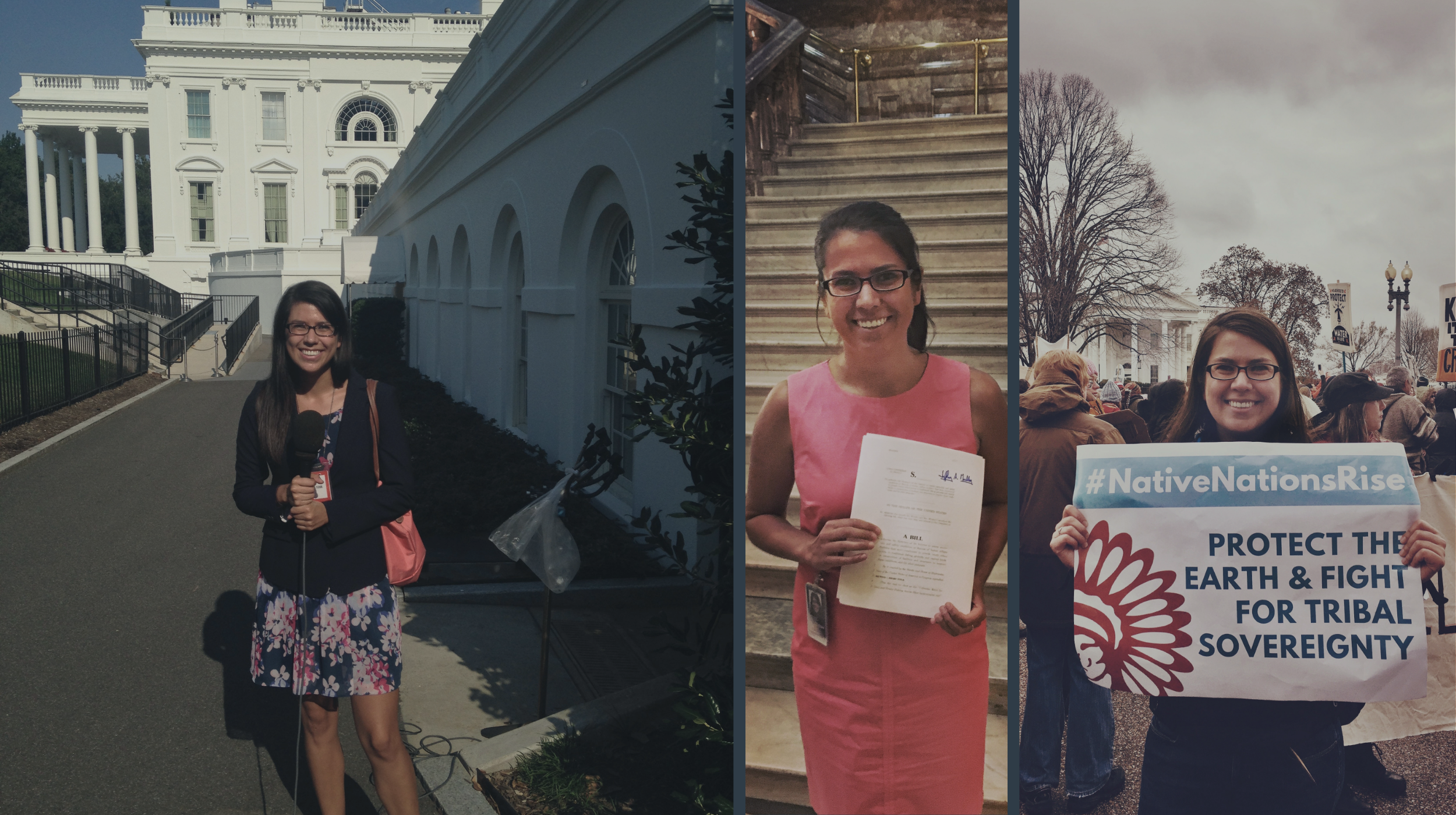
At the White House as a Legislative Assistant in 2015
Touring Lone Pine Oregon’s housing with Senator Jeff Merkley
BUILDING MOMENTUM AT SCALE
After my time in the Senate, I worked at the National Congress of American Indians (NCAI), where I led work with the Native Farm Bill Coalition.
When I started, Tribal representation in the Farm Bill was minimal. By the time we were done, that had shifted significantly. We secured dozens of Tribal provisions because we didn’t just show up with one message. We built a coordinated effort with a strategic approach:
Meeting with every Agriculture committee member
Tailoring conversations to each region and highlighting which Tribe was in their district
Creating accessible materials that met people where they were
Building a network of engaged stakeholders across Indian Country
That work reinforced something I still believe today: alignment and clarity create momentum.
WHAT ACTUALLY MAKES AN ARGUMENT STICK
A strong policy argument isn’t just logical — it’s human.
You have to understand your audience, including their concerns, their pressures, and the potential downside of supporting your issue. Decision-makers are always asking: “What happens if I say yes? Who pushes back?”
If you can answer those questions while also connecting emotionally, your argument has a chance to stick.
But you also have to be concise. In many Senate meetings, you have minutes — not hours — to make your case. The ability to distill something into its clearest, most compelling form is a skill that matters at every level.
WHAT I CARRY FORWARD
Looking back, my time in the Senate and at NCAI taught me that power is more fluid than people think. It shifts. It’s situational. And it’s not reserved for the most senior person in the room.
No matter your title, you can influence outcomes if you understand the issue, do the work, and communicate clearly.
That perspective shapes how I work today. Whether I’m supporting a Tribal program, a nonprofit, or a partner organization, I’m still doing the same core work:
Distilling complex ideas into clear messaging
Helping people understand their audience
Building strategies that align story, timing, and relationships
Because at the end of the day, the same principles apply.
Stories move policy. Relationships move funding. And clarity is what makes both possible.