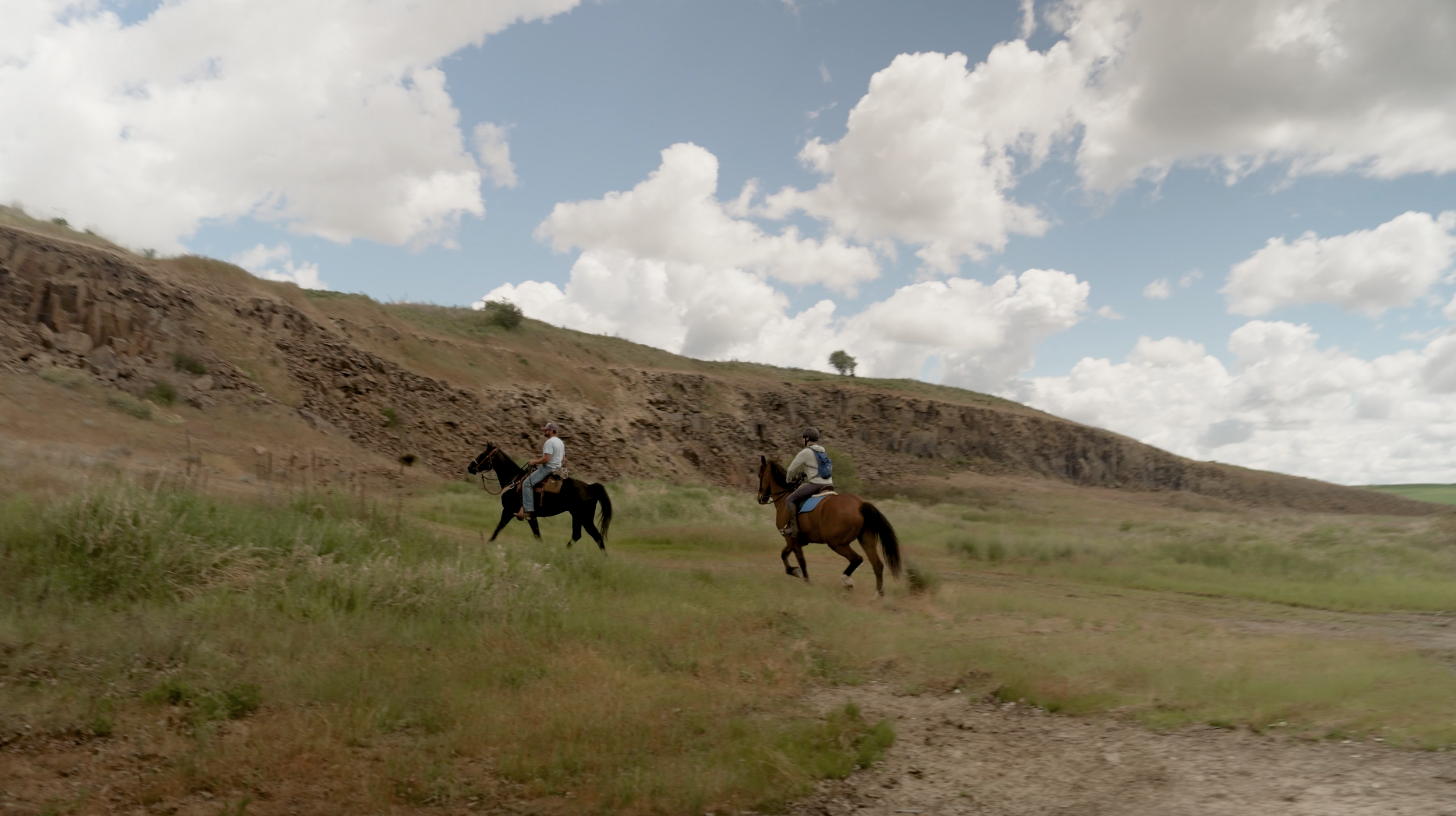
Horses have been part of the Coeur d’Alene way of life for centuries.
My family, the SiJohn-Garry family, has a long history of horsemen. In the 1980s and 90s, there were horse races in Lovell Valley, and my family helped set up the first Steptoe memorial rides. I grew up seeing that horse way of life firsthand.
This spring, I worked with the Coeur d’Alene Tribe to document two events centered around horses: Khwele New Riders Day and the revived Steptoe Battle Memorial Ride.
I went into the project thinking I knew a lot about the story. I came away realizing I still had a lot to learn.
THE HORSE WAY OF LIFE:
DOCUMENTING COEUR D’ALENE CULTURE
OUR HISTORY WITH HORSES
Horses were once central to Coeur d’Alene life. They let our people travel across our large homelands, gather traditional foods, and protect one another.
That history is part of the Steptoe Battle Memorial Ride. In 1858, Coeur d’Alene, Spokane, and Palouse people rode out to protect Tribal people gathering camas when U.S. cavalry entered the area. The ride retraces that history on horseback.
Documenting it felt personal to me because my family was heavily involved in the ride decades ago. Seeing people bring it back felt both familiar and important.
Horse culture at Coeur d’Alene isn't as strong today as it once was. But people are working to rebuild that connection through rides, camps, and opportunities for young people to simply be around horses.
Sometimes cultural revitalization starts exactly that simply: getting people back out there.
THE HORSE WAY OF LIFE:
DOCUMENTING COEUR D’ALENE CULTURE
A few weeks before the Steptoe ride, I filmed Khwele New Riders Day, where kids and community members could spend time with horses and learn to ride.
My biggest observation was: kids are way less afraid of horses than adults. The adults can get in their heads. The kids just want to get out there.
At one point, a little boy told me that while he was riding, he could feel the spirit of the horse. That was probably the sweetest thing I heard all day.
There is a lot of history behind why rebuilding these relationships matters. But you don't necessarily have to explain all of that to a five-year-old. A five-year-old can understand the spirit of the horse all on their own.
LETTING KIDS MEET THE HORSES
One of my favorite parts of documentary work is that the best moments are often the ones you never plan for.
I've known Dixie Stensgar my whole life. She works for the Tribe's Culture Department, loves horses, and was one of the elders ready to get up and ride. I put a microphone on her because sometimes she says funny stuff.
Then she started praying.
I hadn't planned for the prayer. I didn't even know she was going to give one. But it was beautiful, and it ended up becoming the monologue that carried the video.
Those are the moments you can't write into a production plan. They happen because you're there, listening and paying attention.
THE STORIES YOU DON'T PLAN
This project challenged some of my own assumptions.
Because I grew up in a family where horses were a big part of life, I assumed some of the community members I interviewed would have similar experiences. But they didn't.
Families from different parts of the reservation could have completely different relationships with horses, even if they grew up only 15 or 20 miles away from where I did or where my family did.
I had to check myself, change some of my questions, and meet people where they were. It was a good reminder that being from a community doesn't mean you automatically know everybody's story. Even for me, as a Coeur d’Alene person telling a Coeur d’Alene story, I still have a responsibility to listen first and approach everything with humility.
That's what I hope these videos can do, too: document the people keeping this tradition alive, help younger generations become curious about the horse way of life, and preserve these stories as our community continues bringing that connection back.
Sometimes the best thing you can do as a storyteller is keep the microphone on, listen, and let the story find you.